
Where the Sage Glows: A Pandoran Forager’s Lament
Unlock the secret to harvesting exquisite Sage Mushrooms in the Clouded Forest using Na'vi Senses, guiding you to the precise cave near Meadow's Edge.
In the perpetual twilight of Pandora’s deepest grottoes, a quiet phosphorus burns. It is not the bioluminescence of swaying fronds nor the flitting of woodsprites, but something far more elusive—the Sage Mushroom. To the wandering Na’vi and the human echoes who now tread lightly upon Eywa’s woven skin, this unassuming fungus is a keystone of sustenance, its flavors unlocking not just a meal but a memory of the earth. Yet most who venture into the shadows return with only a handful of common caps, their fingers untouched by the higher qualities that whisper of starlit mastery. The pursuit of a superior or exquisite Sage Mushroom becomes a pilgrimage, a dance with patience where the cave itself serves as both altar and adversary.
One must first attune their senses, an act of surrender rather than command. By opening the Hunter’s Guide and pinning the fungus, the seeker inscribes a sacred glyph upon their awareness. From that moment, any Sage Mushroom glimpsed through Na’vi Senses will ignite with a gentle golden halo, as if Eywa herself has drawn a ring of dew around the find. This transformation is not mere convenience; it is the forest speaking in a dialect of hues, distinguishing the desired from the ordinary throng. The technique turns a chaotic thicket into a ruled manuscript, each glowing cap a luminous footnote. Some elders compare the effect to seeing a thread of afternoon sun stitched through a canopy of ink—an embroidery that only the worthy can read.
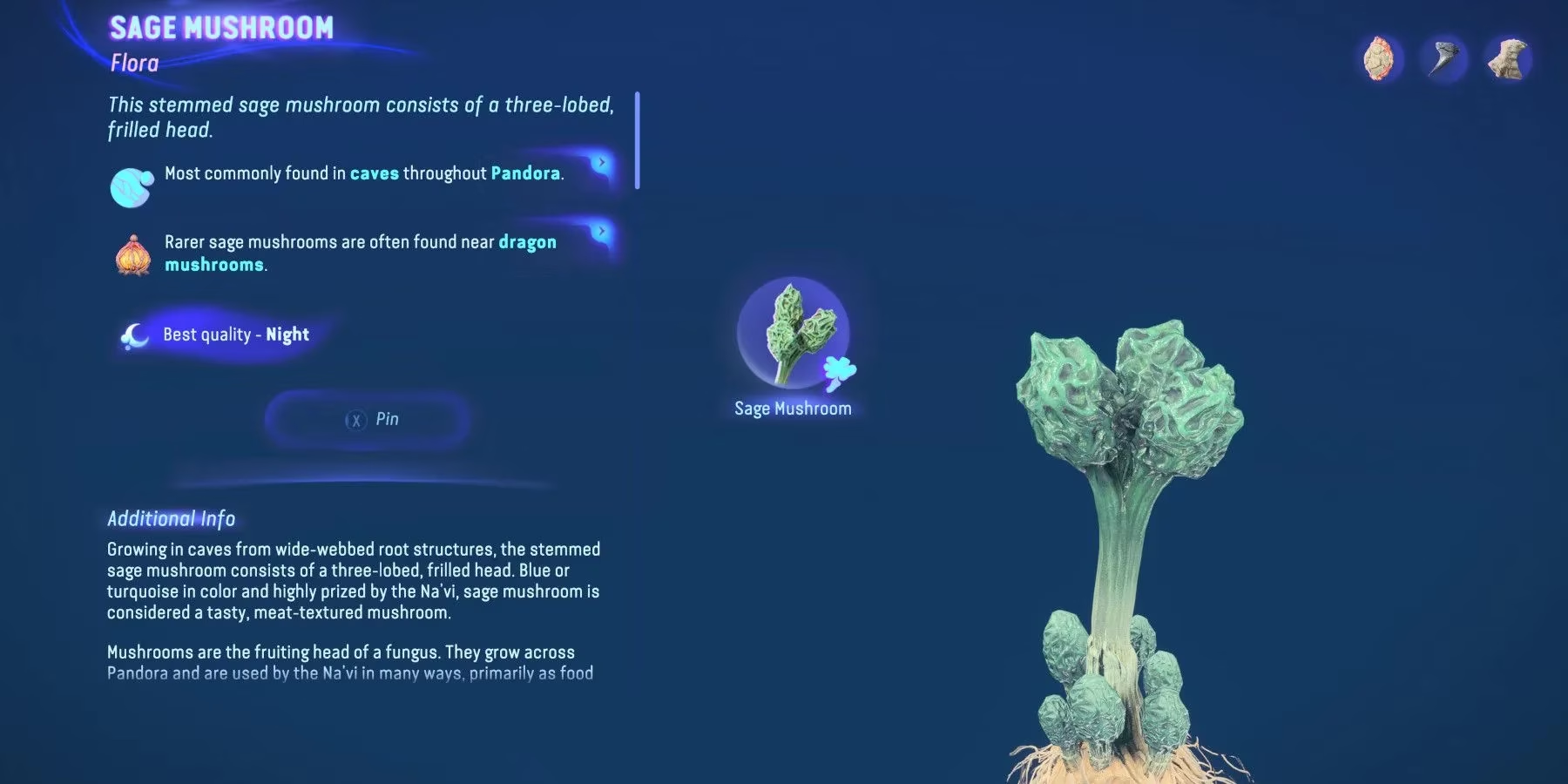
The geography of rarity, however, is carved into the land with deliberate fingers. Not every hollow in rock or water-carved tunnel will yield more than the modest ‘fine’ specimens. True hunters, those with a cartographer’s heart, trace their journey toward the Clouded Forest’s southwestern crook, a domain known as The Cut. Here the mist clings like a ghost’s breath to the boughs, and the air feels heavy with unspoken riddles. Tucked into this realm, about four kilometers south of the main Resistance Hideout, lies a place of respite and research: Meadow’s Edge. This Resistance Field Lab sits beside a river that sings in low gravel tones, its bank sculpted into a lazy curve. And there, precisely where the water bends like the elbow of a sleeping giant, the mouth of a cave opens.
That entrance is a threshold into another tempo. Inside, the darkness does not simply lie—it coils, thick and patient, until the apprentice’s Senses tear it apart. The mushrooms within are siblings of shadow, growing in clumps that resemble ossified coral reefs from an ocean that never was. A visitor who initiates an inspection will see each specimen’s secret written in spectral text: fine, superior, or, on rare benedictions, exquisite. These latter two rarities are the flutters of a hummingbird’s heart—unpredictable, electric, utterly absent until they are suddenly there. A forager might walk the entire cave and find only the common grade, and in that moment the silence feels like a mockery. The antidote is not fury but the long watch.
Those who understand the rhythm of renewal know what to do. Every cap, even the humble, must be harvested. The cave, stripped bare, becomes a womb waiting to quicken again. Afterwards, one retreats to the Meadow’s Edge campfire, a circle of embers that whispers stories to the night. Several in-game days must pass—a span measured in the slow blink of the gas giant Polyphemus overhead. When the hunter returns to the cave’s cool exhale, the spawns will have reshuffled, and the shimmer of superior or exquisite might finally stain the gloom. It is a gamble shaped like patience, the same gamble a cliff-dwelling banshee takes with the wind.
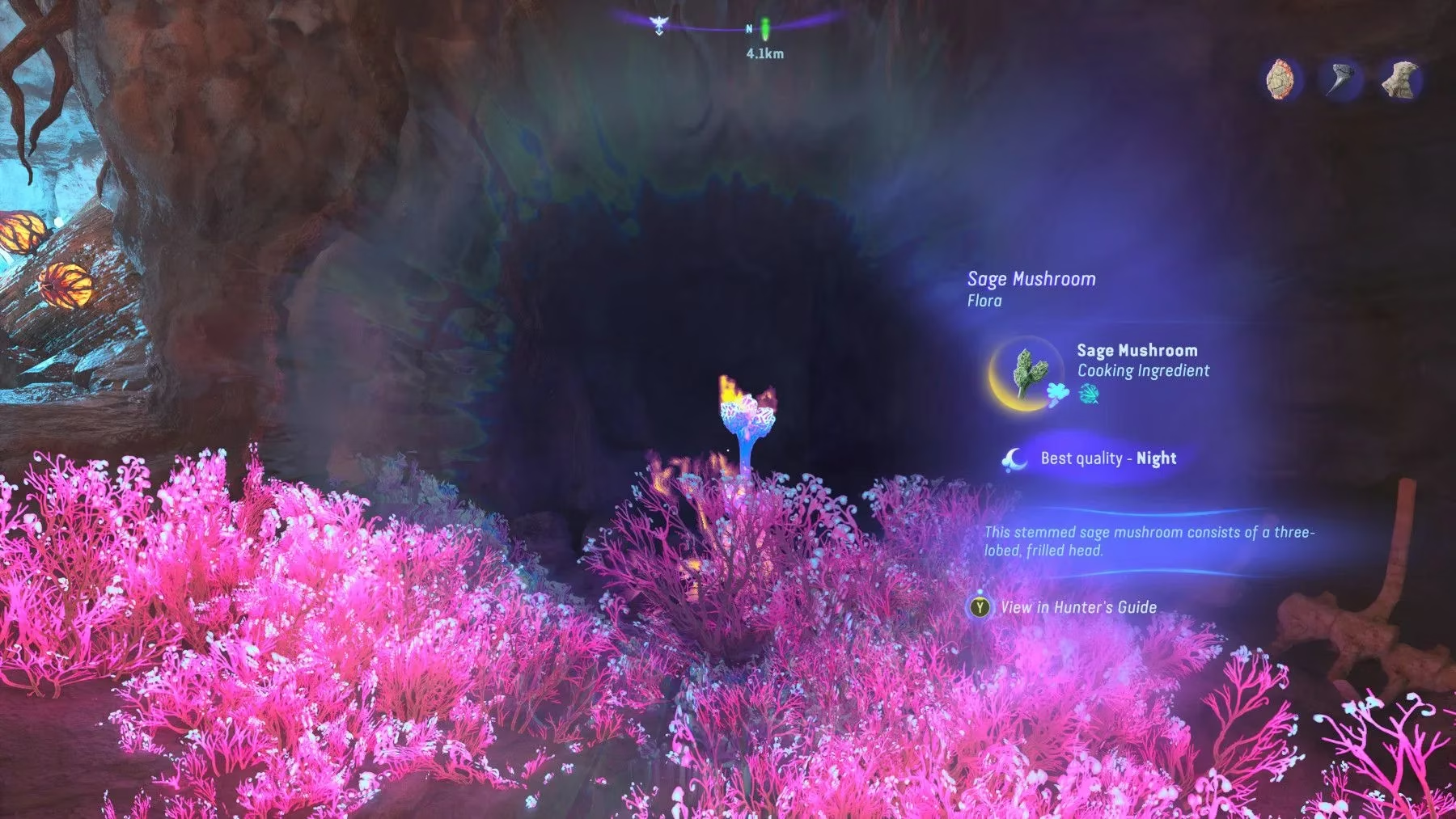
The old lore woven into the Hunter’s Guide adds texture to this ritual. Nighttime, it declares, is when the Sage Mushroom’s potential crests. To harvest a pristine specimen, one must also pull the stalk with a leftward tilt and a downward press—a motion akin to coaxing a slumbering bird from its nest without waking it. Yet the guide’s wisdom is a gentle deception here; these finicky bonuses, while poetically satisfying, have scant bearing on the mushroom’s true culinary potency. A sun-plucked or rain-soaked sample, if it bears the exquisite mark, will flavor a dish as vividly as any midnight-picked twin. The hunters who roam the Clouded Forest in 2026 have learned to treat these instructions not as rigid laws but as the nostalgic verses of a lullaby—beautiful, comforting, but not the force that fills a stew.
The deeper metaphor of this pursuit, however, cannot be ignored. The cave at the Cut is like a celestial cave painting where the pigments are alive, revealing themselves only to those who have memorized the underside of the world. Each superior mushroom is a small thunderbolt caught in amber, and each exquisite find is a page torn from a book of hours that was buried before the first songcord was strung. Hunters speak of the moment the golden ping of a rare grade appears as “hearing the color of silence,” an auditory hallucination of the soul when the eyes alone cannot bear the joy.
The significance of Meadow’s Edge itself cannot be overstated. It is more than a camp; it is the needle’s eye through which the thread of success passes. By using its fire to accelerate the dial of time, players weave themselves into the loom of respawn cycles without the fatigue of true waiting. The river beside the lab is a constant, gurgling reassurance that the cave’s heartbeat will soon synchronize with their own. In an almost ritualistic act, seasoned foragers will sit by that campfire, listening to the crackle, watching the faux stars wheel, and imagining the mycelial web beneath the stone already knitting new miracles.
And yet, for all the technique and location scouting, the Sage Mushroom remains a masterclass in surrender. It is a truffle of the spirit, demanding that the hunter abandon the arrogance of certainty. One might enter the cave a hundred times and leave with a hundred fine specimens, the backpack heavy with mediocrity. Then, on the hundred-and-first, without warning, an exquisite specimen will crouch in a crevice like a tiny moon fallen from a bigger sky. The yield is never owed; it is only gifted. That, perhaps, is the final lesson Eywa teaches through these phosphorescent tutors: that the best ingredients are not collected but remembered into being by a world that watches back.