
Ubisoft's Open-World Formula Faces Scrutiny as Far Cry 7 Approaches in 2026
Far Cry 7 stands as the pivotal last stand for Ubisoft's open-world formula, a once-celebrated blueprint now criticized as repetitive and derivative. The game must either deliver groundbreaking innovation or risk being forever entombed by its own legacy.
The open-world gaming landscape in 2026 stands as a monument to excess, a sprawling digital empire built upon foundations laid decades ago. While the genre's origins can be traced back to the humble beginnings of the 1980s, it was the seismic impact of titles like Grand Theft Auto 3 that truly flung the gates wide open, unleashing a tidal wave of ambition. For years, one publisher, Ubisoft, was hailed as the undisputed master architect of these virtual playgrounds, weaving its signature formula into franchises like Assassin's Creed and Far Cry with mechanical precision. Yet, as the industry marches forward, that very same award-winning blueprint has transformed from a badge of honor into a heavy chain, dragging down innovation. Now, all eyes are fixed on the horizon, where Far Cry 7 looms not just as another sequel, but as a potential last stand—a game that must either shatter the mold or be forever entombed within it.
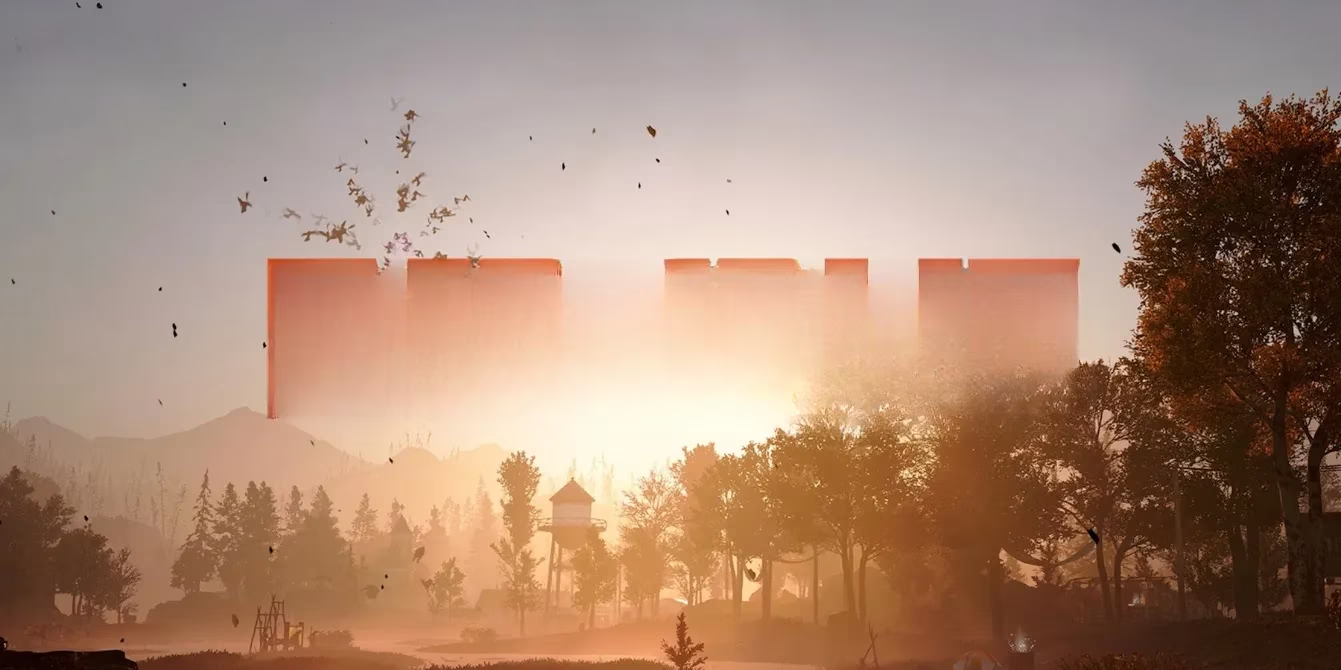
Ah, the infamous formula! It was born not in malice, but in triumph with Far Cry 3. Players were utterly captivated by its intoxicating core loop: the silent, methodical conquest of enemy outposts, the thrilling hunt for exotic wildlife, the satisfying grind to upgrade gear, and the progression through a chaotic main narrative. It was a recipe for success so potent that Ubisoft could not resist pouring it into every bowl in its kitchen. The formula seeped into the veins of Assassin's Creed, transforming historical stealth into checklist tourism. It rebuilt Ghost Recon from the ground up. It defined new IPs like The Division. For a glorious, shining moment, it felt like Ubisoft had cracked the code to perpetual player engagement.
But repetition is the enemy of wonder. What was once a thrilling novelty became a predictable chore. The magic faded. The outposts all started to look the same. The hunting quests felt like busywork. The gear upgrades became a monotonous treadmill. A damning consensus emerged among the gaming faithful: if you had played one modern Ubisoft open-world game, you had, in essence, played them all. The publisher's vast portfolio, once a tapestry of diverse experiences, began to feel like a hall of mirrors—endlessly reflecting the same familiar structures.
The situation has only grown more dire with time. Take the recent Avatar: Frontiers of Pandora. On paper, the Ubisoft formula—liberating the environment, crafting from nature, conquering human outposts—should have been a perfect fit for Pandora's ecosystem. And yet, the experience was haunted by an overwhelming sense of déjà vu. Players found themselves performing the same actions they had executed a hundred times before in Kyrat, ancient Greece, or post-pandemic New York. The stunning alien world felt trapped inside a painfully familiar cage. This derivative feel is the clearest signal that the formula has overstayed its welcome.
If Ubisoft's open-world empire has a crumbling pillar, it is undoubtedly the Far Cry series. While Assassin's Creed can lean on its ever-changing historical tourism and Ghost Recon on its tactical co-op, Far Cry's primary identity is its visceral, first-person gameplay sandbox. And that sandbox has not seen a new, truly groundbreaking toy in over a decade. Every entry since the revolutionary Far Cry 3 has felt like a variation on a theme, a reskin of the same fundamental experience with a new villain and a new map. The fatigue is palpable. The series is screaming for reinvention.
Therefore, the mandate for Far Cry 7 in 2026 is not merely to be good—it is to be different. It must commit outright rebellion against the old ways. The development team needs to ask radical questions:
-
What if the game abandoned the cluttered map of icons and embraced true, discovery-driven exploration, perhaps taking inspiration from the masterful, hands-off worlds of The Legend of Zelda: Breath of the Wild and Tears of the Kingdom?
-
What if the protagonist was not another silent cipher, but a character with deep, branching narrative agency that meaningfully changes the world?
-
What if the setting was not just another tropical or mountainous region, but something genuinely unprecedented—a decaying orbital habitat, a fantastical bio-punk city, or a reality-bending psychological landscape?
-
What if the core activities were not about clearing checklists, but about surviving dynamic, systemic events that reshape the playing field?
The emphasis must shift dramatically. The goal cannot be to fill a progress bar by completing 50 identical side activities. The heart of Far Cry 7 must be a compelling, character-driven narrative and a world so intrinsically interesting that players explore it not for a reward marker, but for the sheer joy of discovery. The hand-holding must vanish, replaced by trust in the player's curiosity and competence.
| The Old Formula (Stale Bread) | The New Hope (Fresh Banquet) |
|---|---|
| 📋 Icon-cluttered maps | 🗺️ Organic, discovery-driven exploration |
| 🔄 Repetitive outpost liberation | ⚙️ Dynamic, systemic world events |
| 🎭 Silent, generic protagonist | 🎬 Complex protagonist with narrative weight |
| 🏝️ Familiar wilderness settings | 🌌 Unprecedented, genre-bending locations |
| ✅ Completionist checklist design | ✨ Emergent, player-authored stories |
The gaming world in 2026 is a different beast. Players are wiser, more discerning, and hungrier for authentic experiences than ever before. They can smell a reheated formula from a mile away. For Far Cry 7 to not just survive but to once again lead the charge, it must do the one thing Ubisoft has avoided for a generation: it must burn the blueprint. The path forward is not through incremental iteration, but through bold, fearless innovation. The future of one of gaming's most iconic franchises depends on it. Will Far Cry 7 be the phoenix, or will it be the ashes?