
The Silent Launch of Avatar Frontiers of Pandora and What It Reveals
Avatar: Frontiers of Pandora open world game launched quietly, missing blockbuster marketing and buzz, reflecting Ubisoft's shifting strategy.
The year 2026 saw a curious phantom haunting digital storefronts: a lush, sprawling open world that arrived almost without a whisper. When Avatar: Frontiers of Pandora finally emerged, it was met with a silence so profound it became its own strange form of notoriety. People weren’t talking about the game; they were talking about how nobody was talking about it. Social media timelines filled with a familiar script, an echo of the phenomenon that had surrounded The Way of Water back in 2022, when millions insisted they didn’t know a single person who had seen the film while it cruised past two billion dollars. The difference this time was that the blockbuster cash registers were not ringing in secret. It was not a stealth hit, but an unfinished sentence left hanging in the air, a firework that fizzled out in the damp before it could even scratch the night sky.
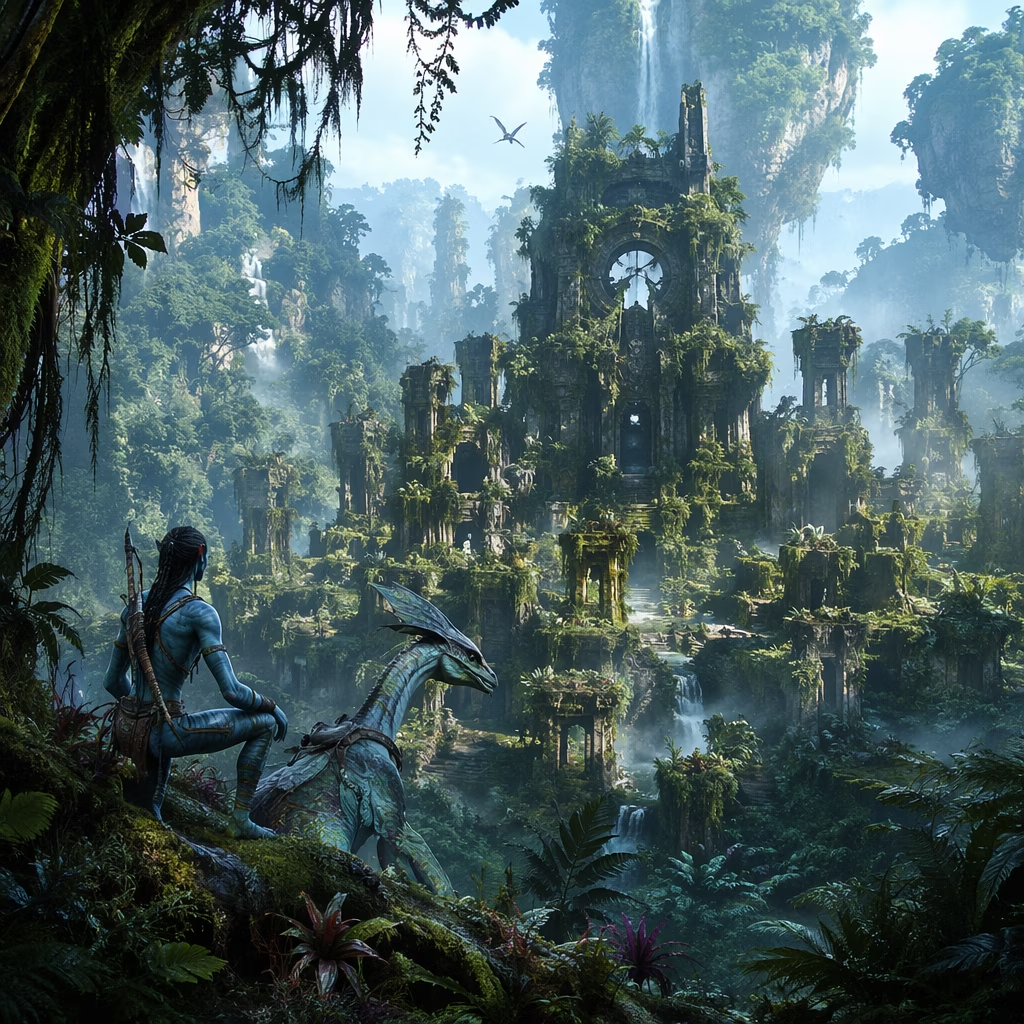
It did not have to be this way. Ubisoft’s one major open-world spectacle of 2023—because the lean Assassin’s Creed Mirage hardly qualified as a giant—was unceremoniously planted into the calendar during the week of The Game Awards, as if hoping to be mistaken for confetti. Advertising was a ghost of a whisper. When people later claimed they never even knew the game was releasing, most were not being facetious. The trail of information was barely a breadcrumb: a flashy 2022 announcement, a lengthy delay into the following year, a handsome gameplay showcase during a summer Ubisoft Forward, and then a vacuum. The ship was launched without a horn to announce its departure, and the ocean swallowed the sound.
The marketing that did exist was more of a treasure hunt than a campaign. Ubisoft’s own YouTube channel housed a couple of lovely making-of featurettes, exploring the hauntingly beautiful score and the studio Massive’s close collaboration with James Cameron’s Lightstorm Entertainment. A wonderful interview appeared on IGN, with producer Jon Landau unrolling the mission statement: this was to be an authentic extension of the Avatar universe, a true canon entry. Early previews, like one penned by Jade King, glowed with promise. Yet these gems required a map and a shovel to find, while a typical Ubisoft launch would have plastered the world with noise. For Far Cry 6 in 2021, Giancarlo Esposito’s face had scaled skyscrapers across the globe. By contrast, Frontiers of Pandora received a postcard where a billboard should have been.
This quiet retreat was not just a curious choice; it was a symptom. Ubisoft had changed. Between the release of Far Cry 6 and the arrival of Frontiers, the company weathered brutal financial winters and leadership storms. Mass layoffs swept through its teams—more than a hundred employees lost in a single month in late 2023. Projects still in development were pruned away so the publisher could focus on core franchises. The Avatar game, had it not been so close to completion, might well have been one of those casualties. The company was simply no longer in a position to light the same old marketing bonfires. Resources were tight, belief was rationed, and Frontiers of Pandora began to feel like a beautiful, fragile dragonfly that had been bred in captivity and released too late in the autumn, its wings still shimmering but the air already too cold for flight.
What stung the most was that the game itself was far better than the silence suggested. It was, by many accounts, the best-looking title of its year, an uncontested visual triumph in a barren December. Its Metacritic score settled around 73, a perfectly respectable number that had propelled Far Cry 6 to roaring commercial success. The issue was never the quality of the open world, the joy of soaring on an ikran, or the tangible sense of a living, breathing Pandora. Instead, the launch became a Rorschach test for Ubisoft’s marketing muscle, or rather its atrophy. Much like Mario + Rabbids: Sparks of Hope, another gem that had earlier struggled to find its audience through no fault of its own, a commercial disappointment for Frontiers of Pandora would not condemn the game or the franchise. It would merely document a company that had forgotten how to tell the world its own stories.
Looking back from 2026, the echoes of that silent launch still ring in boardrooms and fan forums alike. The Upper Plains of Pandora remain a masterstroke of world-building, a place where players could lose hours simply listening to the hum of alien flora. But a masterpiece kept in a drawer gathers no gasps. Ubisoft’s Avatar adventure stands as a parable: in an era of endless digital shouting, even a next-generation miracle can vanish if no one knows where to look. The lesson was not that the game was unremarkable. It was that even the brightest bioluminescence cannot be seen from outside a closed box.