
How Avatar: Frontiers of Pandora's New Clans Could Shape James Cameron's Next Sequels
Avatar: Frontiers of Pandora game and Avatar film canon unite, enriching the saga with new Na’vi clans and official lore for future sequels.
When James Cameron unleashed Avatar in 2009, it redefined visual storytelling with pioneering motion capture and lush 3D world‑building. Over a decade later, Avatar: The Way of Water proved the franchise’s enduring grip on global audiences. But while moviegoers wait for the next cinematic chapter, Ubisoft’s Avatar: Frontiers of Pandora has quietly become a treasure trove of living canon that future films could mine. Released back in December 2023, the open‑world action‑adventure wasn’t just another licensed tie‑in—it was granted official canonical status. That means every clan introduced, every battle fought, and every ruin left behind in the Western Frontier is part of the same universe Jake Sully and Neytiri inhabit.
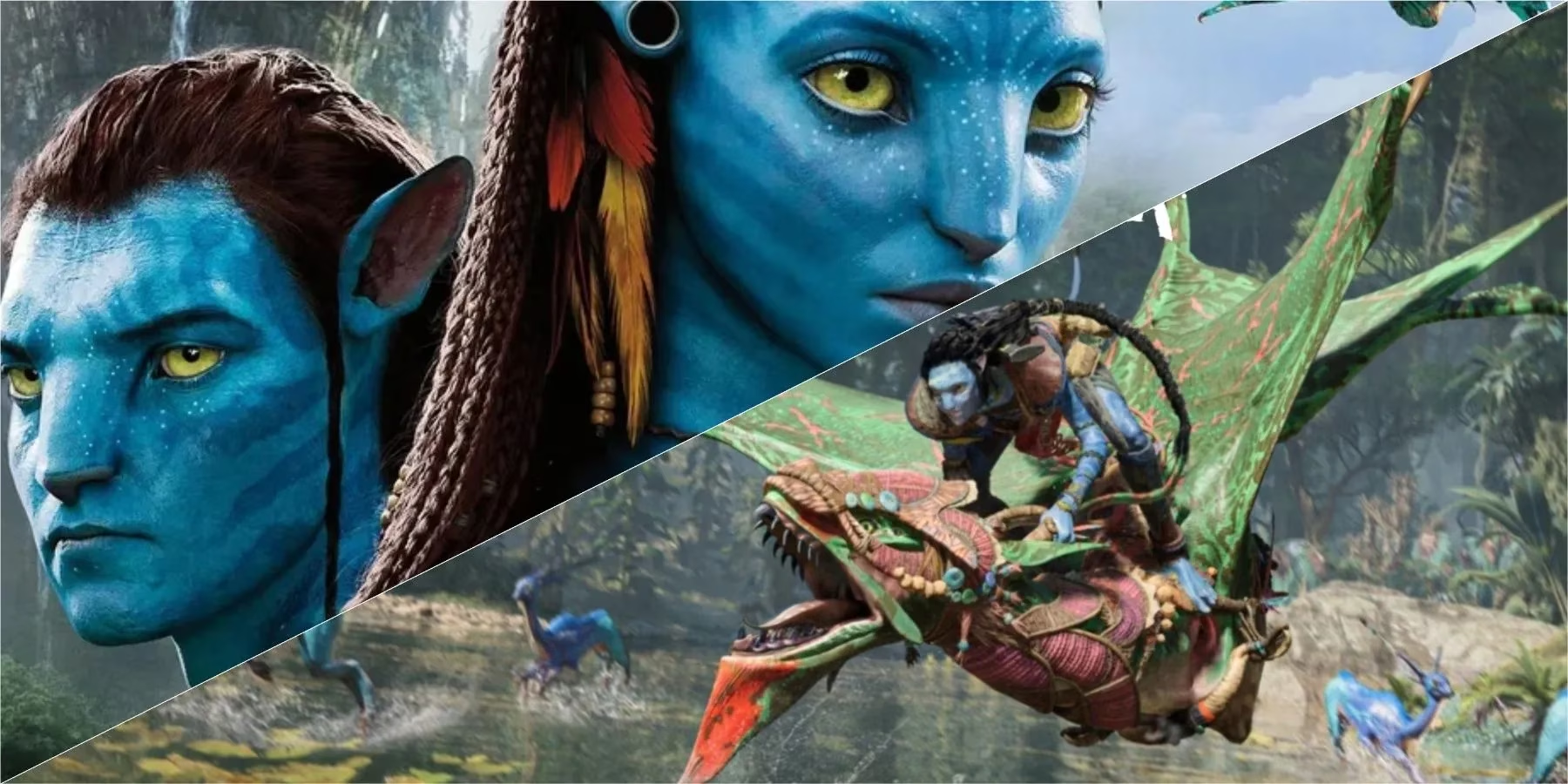
Many films based on games struggle to bridge the two mediums, yet Frontiers of Pandora flips the script: it enriches the film canon directly. Players step into the body of a young Na’vi who was abducted by the Resources Development Administration (RDA) as a child and later awakens to reclaim their heritage. Through this journey, the game introduces four distinct Na’vi clans, each with traditions, territories, and philosophies that feel far too substantial to remain confined to a single title. If even a fraction of this lore makes it into Avatar 3 or beyond, audiences are in for a deeply expanded Pandora.
A Canonical Anchor
From the outset, Massive Entertainment worked closely with Lightstorm Entertainment to ensure narrative alignment. The game’s events—from its explosive main story to its more contemplative side missions—are deemed part of the Avatar timeline. This raises an intriguing question: how will James Cameron’s sequels, which now sprawl across multiple planned installments, acknowledge the liberation of the Western Frontier or the near‑extinction of the Sarentu clan? Given the filmmaker’s meticulous control over his universe, it’s plausible that future screenplays already contain threads planted by the game’s writers.
The Four Clans of the Western Frontier
If any element leaps from the game into future films, it will almost certainly be these newly minted Na’vi societies. Let’s break them down:
🌿 Aranahe Clan – Peaceful silk‑weavers who dwell inside a colossal Hometree. Their mastery of textile arts and diplomacy makes them a cultural anchor. Could we see their intricate fabrics adorning characters in a future movie? A subtle nod would delight gamers without confusing cinema‑only viewers.
🐃 Zeswa Clan – Nomadic hunter‑gatherers who roam the open plains with the mighty zakru, massive horned creatures. Their deep bond with these beasts and their mobile lifestyle present a stark contrast to the forest‑dwelling Omatikaya. A chase sequence or a coming‑of‑age ritual with the Zeswa would offer visually spectacular cinematic moments.
🍃 Kame’tire Clan – Reclusive healers hiding deep within the Clouded Forest, openly wary of both RDA and other Na’vi. Their mastery over Pandora’s flora and their isolationist stance create a tense, mysterious atmosphere. Introducing them in a film could explore themes of trust and the ethical use of Pandora’s biosphere, especially if human scientists try to exploit their knowledge.
⭐ Sarentu Clan – Arguably the most pivotal. Formed three millennia ago by Entu, the very first Toruk Makto who left the Omatikaya, the Sarentu were traveling storytellers and diplomats. The game reveals they were systematically ambushed and slaughtered by the RDA, leaving the player‑character and a handful of peers as the last survivors. Frontiers of Pandora ends on a note of both grief and resilience; the Sarentu must decide what it means to rebuild. This open‑ended conclusion practically begs for cinematic continuation. Why would the franchise’s first Toruk Makto’s legacy be consigned to a supplementary narrative? A cameo or a reference in Avatar 3 could honor the game’s emotional arc while pushing the overarching plot toward unification of all Na’vi against the RDA.
The Western Frontier: A New Cinematic Stage
Though the bioluminescent jungles and floating Hallelujah Mountains remain iconic, Frontiers of Pandora proves the planet has more biomes to offer. The Western Frontier features sprawling savannas, misty cloud forests, and the wreckage of RDA excavation sites. As Jake Sully and his family flee their familiar territories, the sequels will need fresh environments. Imagine the camera panning over the shattered remains of an RDA drilling outpost—destroyed by the game’s protagonist—while the film’s heroes pass through, remarking on the fervor of local resistance. This would not only reward gamers but also give depth to the world‑building, showing that the war for Pandora is being waged on multiple unseen fronts.
What’s more, the game’s exploration of the RDA’s industrial cruelty—kidnapping Na’vi children for indoctrination—adds a grim layer that the films have only touched upon. Folding this darker aspect into a future screenplay would raise the emotional stakes, giving characters like Spider or Kiri even more reason to fight.
Why Now?
With Avatar 3 reportedly deep in post‑production and a projected 2025 release (now pushed to 2029 according to recent updates), the timing couldn’t be better. The game’s fanbase has spent years immersing themselves in the Western Frontier’s lore, and the cultural conversation has already primed audiences for these clans. Ignoring them would feel like a missed opportunity. After all, transmedia storytelling is no longer a gimmick; it’s expected by modern viewers who juggle multiple platforms. The Marvel Cinematic Universe’s integration of Disney+ shows proved that cross‑medium canon works, and Avatar can do the same.
Of course, Cameron is known for following his own vision. But given that Frontiers of Pandora was built from the DNA of his universe, its elements are less an outside imposition and more a natural extension. As the franchise barrels toward its epic conclusion, the question lingers: will the Sarentu rise from the ashes on the silver screen? Only Pandora knows—but the seeds have certainly been planted.