
How Avatar: Frontiers of Pandora Masters the Art of Fan-Service Without Feeling Cheap
Avatar: Frontiers of Pandora turns fan-service into sacred ritual, expanding iconic Ikran bonding with painstaking authenticity and emotional depth.
Fan-service often walks a tightrope stretched over a chasm of cringe, where one misstep can plunge a beloved franchise into a pit of eye-rolls and groans. In the wrong hands, it becomes a desperate checklist of nostalgia triggers—like a chef who dumps every spice from the rack into a soup, hoping something will taste familiar. Yet, against all odds, Avatar: Frontiers of Pandora sidles up to this high-wire act with a cheeky grin and executes a backflip. The game not only embraces fan-service but treats it like a sacred ritual, stirring the emotional cauldron of James Cameron’s universe with the precision of a Na’vi arrow hitting a Thanator’s weak spot.
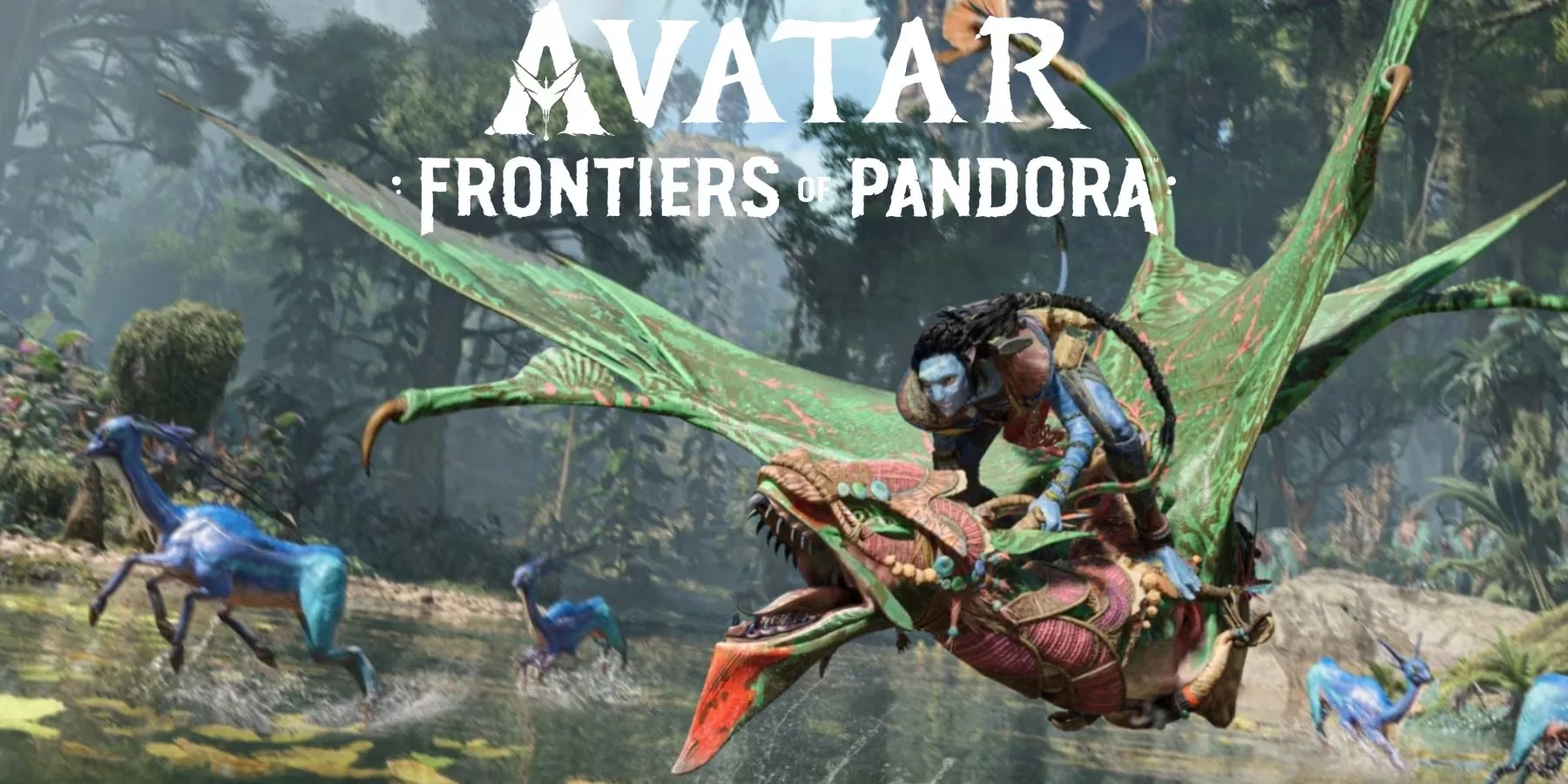
Now, anyone who watched the pre-release trailers through their blue-tinted glasses could smell the whiff of Far Cry DNA wafting from the gameplay. But what really hooked early skeptics was the atmosphere—a Pandora so painstakingly authentic it felt like slipping on a pair of well-worn soft-vision goggles. And now, years after its 2023 release, the verdict is in: Frontiers of Pandora leans so hard into fan-service that it practically falls over, yet it somehow lands in a graceful crouch.
Borrowed Beats, Fresh Spirits
The game’s plot is essentially a greatest-hits album remixed with surprising depth. Players inhabit a young Na’vi who, instead of a wisecracking marine in an avatar body, has spent his whole childhood stuffed inside an RDA cage like a mistreated pet. Breaking free, this protagonist doesn’t just learn to survive—they must reunite three squabbling Na’vi clans across the Western Frontier, all while reconnecting with a world that was stolen from them. If the first film was a fish-out-of-water tale, Frontiers of Pandora is more like a bird released from a mine shaft, blinking at the sun it was born to fly under.
The structure echoes Jake Sully’s journey so closely that at times you half-expect Sam Worthington’s voice to echo from the trees. But the game sidesteps plagiarism by digging deeper into the rituals. Learning the Na’vi language here isn’t a montage; it’s a tactile, sprawling process. Players aren’t just spectators to ancient ceremonies—they clumsily participate, fumbling through traditions and earning their place. The result feels less like a cover song and more like a remix that adds a haunting new bridge.
The crown jewel of borrowed spectacle is the Ikran flight. That moment when Jake first tames his banshee in the movie—wind screaming, heart thumping, a bond sealing with a shriek—gets resurrected here with such loving attention that it’s basically a theme park ride built by devotees. The player’s first bonding with their Ikran doesn’t just copy the beats; it expands them. The climb to the peak feels more perilous, the creatures more distinct, and the subsequent dive is a gut-punch of joy. It’s fan-service that functions like a masterly arranged piece of music, where you recognize the melody but are stunned by the new orchestration.
New Lore That Doesn’t Just Fill Gaps, It Builds Bridges
If Frontiers of Pandora were nothing but a tribute act, it would’ve faded into the bioluminescent undergrowth by now. What cements its place in the heart of any self-respecting Avatar obsessive is its addition of canon lore that feels as organic as a woodspite’s glow. The game introduces four entirely new Na’vi clans—the Aranahe, Zeswa, Kame’tire, and the reclusive Sarentu—each with distinct philosophies, crafting styles, and even body ornamentations that could launch a thousand cosplay tutorials.
The game’s codex overflows with entries on new fauna and flora, from the irritable Hammerhead Titanothere subspecies to vegetation that reacts to touch like a shy anemone. This isn’t fluff; it’s the kind of world-building that makes a fan want to curl up with a cup of spiced tea and just read. It’s the difference between a filmmaker who slaps a familiar logo on a lunchbox and one who secretly pens a 200-page encyclopedia of imaginary biology for his own amusement. The developers, clearly, are the latter.
Even the side quests often serve as lore-delivery mechanisms disguised as errands. A mission to collect certain pods might devolve into a crash course on the ecological balance of the Western Frontier, delivered with the earnestness of an Attenborough documentary voiced by a Na’vi elder.
The Sweet Spot of Nostalgia
Fan-service in Avatar: Frontiers of Pandora works because it behaves like a parent who brings out a favorite childhood toy but has secretly upgraded it with new electronics. The memories rush back, but there’s a sparkle of an unfamiliar feature that keeps things fresh. The game understands that what made the film’s moments special wasn’t just the visual spectacle but the emotional resonance—the feeling of connection to a world both beautiful and hostile. By re-creating those moments with interactive context, the game transforms the player from a passive observer into a participant, making the nostalgia feel earned rather than injected.
Compare this to a lesser game that would simply have an NPC mutter, “I see you,” with a wink at the camera. Here, that phrase is drenched in the player’s own journey. When your Na’vi finally bonds with their Ikran, the screen doesn’t flash a subtitle explaining why this is iconic. You’ve climbed the rookery yourself, dodged the jealous beaks of unbonded beasts, and felt the wind shift. By then, you don’t need a wink.
A Deliciously Unsubtle Feat
In an era where fan-service often arrives as a sterile injection of references—a lightsaber here, an Infinity Gauntlet nod there—Avatar: Frontiers of Pandora offers a full-body immersion. It’s the difference between a host who points to a framed photo of a famous relative and one who invites you to a living room that smells exactly like that relative’s house, right down to the peculiar spice in the air. The game may lean on fan-service like a crutch sculpted from unobtainium, but it also uses that crutch to vault over the pitfalls that sink other adaptations. By loving the source material loudly and adding to it quietly, it turns what could have been a cheap thrill into a genuine extension of Pandora’s soul.